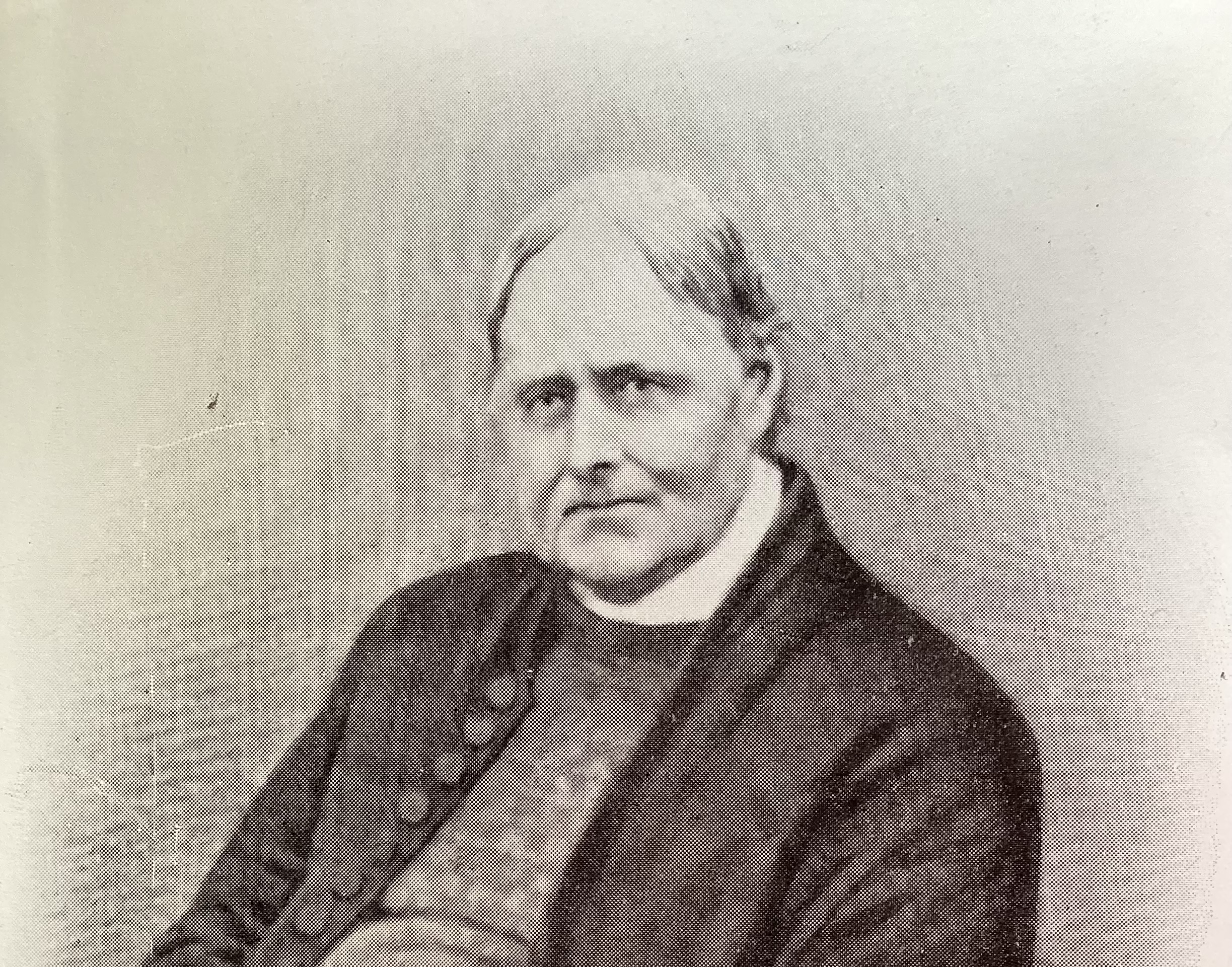
Vicar, poet, tale collector 1803 - 1875
Hawker was born in Plymouth and raised by his grandfather, a very popular preacher known as ‘Star of the West,’ Vicar of Charles Church, Plymouth.
Hawker attended Liskeard Grammar school and then Oxford University. He married a much older woman, Charlotte, whilst still a student, then on graduating prepared for holy orders and was ordained in 1831. After a short stint as a curate in North Tamerton he was appointed vicar of Morwenstow in 1834, and there he stayed for the rest of his life.
He restored Morwenstow Church and built his own vicarage, and established a village school. Kind and impulsive he gave money away and struggled financially in later years.
Morwenstow is on the wild North Cornish coast and Hawker lived there in the days before the Hartland lighthouse was built to warn ships of the treacherous rocks close to shore. There were many shipwrecks, and Hawker buried the wrecked dead, each with his own grave, a grim task.
‘I have suffered so much from their burial in former times that I hear in every gust of the gale a dying sailor's wish.’
He was eccentric and original, branded a ‘dangerous anarchist’ by church authorities, who kept him out of the way at Morwenstow - but his influence was lasting. He held the first Harvest Festival in 1843, and penned the Cornish anthem ‘Trelawny.’
No clerical black for Hawker. He dressed in a long purple coat, fisherman’s gansey knitted by a woman from Clovelly, long boots and a limp white cravat instead of a stiff clerical collar : clothes more suited to the long daily ride between his parishes at Morwenstow and Welcombe, more suited to pulling dead sailors from the sea.
He was always a poet a well as a priest, won the Newdigate Prize for Poetry in 1827. The tales he told in poetry and prose were the true stories tales of legendary people of Cornwall good and bad, wreckers, human giants, shepherdesses made good. He built a hut on the cliffs with timber from 3 wrecks, for reading and writing close to the winds.
Charlotte died in 1863 and after a year of deep depression Hawker married a much younger woman, Anne, 20. They had 3 children and were impecuniously happy.
Hawker died while visiting Plymouth in 1873 and is buried there.
Footprints of Former Men in Far Cornwall 1870
Poetical Works of Rev. R.S. Hawker 1899
The Life and Letters of R S Hawker , C E Byles 1906
https://archive.org/details/lifeandlettersof00byleuoft/page/n7/mode/2up?ref=
https://www.robertstephenhawker.co.uk/
In the footsteps of Robert Stephen Hawker H L Lewis 2009